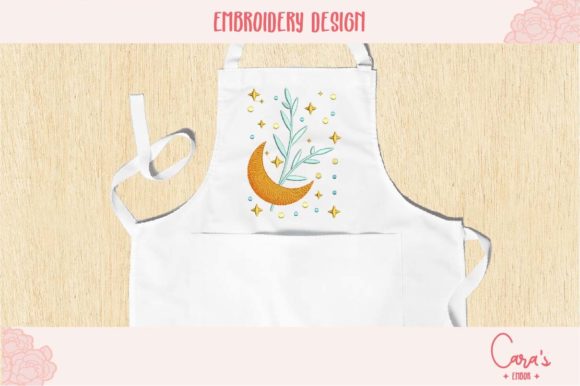
Moon Plants and Stars: A Celestial Embroidery Design Review
First Impressions: Whimsical, Balanced, and Quietly Sophisticated
As an embroidery designer who’s stitched hundreds of commercial projects—from Etsy bestsellers to boutique nursery collections—I opened Moon Plants and Stars expecting either overworked intricacy or oversimplified charm. Instead, I found something rare: a design with breathing room. The composition balances organic plant forms—curving stems, soft fern-like fronds—with subtle crescent moons and scattered stars that feel intentional, not decorative clutter. It’s not fussy, but it’s not minimalist either. There’s gentle movement in the line work, and the implied depth comes from thoughtful layering—not excessive stitch density. This isn’t just a machine embroidery design; it’s a mood-setter.
Fits Naturally Into Real-World Projects
Moon Plants and Stars doesn’t shout for attention—it invites closer looking. That makes it ideal for pieces where subtlety elevates perceived value: linen pillow covers for modern home shops, organic cotton baby blankets, unbleached canvas aprons for artisanal bakeries, or even the inside hem of a silk-lined tote bag. As a Creative Fabrica embroidery asset in the House Home category, it leans into quiet luxury rather than bold statement-making. I tested it as a tote bag design and a sweatshirt embroidery placement (left chest, 3.5” wide), and both felt cohesive—not like an add-on, but like part of the garment’s story.
Performance Across Fabrics and Forms
In real stitching, Moon Plants and Stars behaves thoughtfully. On stable fabrics like medium-weight quilting cotton or terry cloth kitchen towels, the fill stitch areas hold shape without puffing or shadowing—especially when paired with a light cutaway stabilizer. On stretchy fabric like French terry sweatshirts, I added a tear-away + iron-on combo and reduced top tension slightly; results stayed crisp. For curved surfaces—like the front panel of a structured cap—I resized it to 2.75” and used a smaller hoop size; the flowing lines adapted well, with no distortion in the star points or moon curves.
On dark fabric? It shines—literally. With high-contrast thread colors (ivory on navy, silver on charcoal), the satin stitch moon edges catch light beautifully. Tiny details—like the delicate running stitch “twinkles” around each star—remain legible at 3” width, but I wouldn’t push below 2.25” without verifying small-detail clarity on my machine first. No dense, matted zones—so no puckering on lightweight baby muslin or delicate rayon blends.
Commercial Use Considerations for Sellers
If you’re listing embroidered items on Etsy or selling at craft fairs, Moon Plants and Stars supports brand consistency without limiting versatility. It works equally well on gender-neutral nursery decor and elevated kitchen textiles—two high-margin categories. Because it avoids trends (no glitter fonts, no seasonal clichés), it stays relevant year-round. As a personalized gift, it pairs seamlessly with monogrammed initials or custom names placed nearby—not overlaid—keeping focus on its organic rhythm.
Photography benefits too: the contrast between botanical softness and celestial geometry creates natural visual interest in flat lays and lifestyle shots. Customers linger longer on product images featuring this kind of layered storytelling—and that translates directly to engagement and conversion. For digital sellers offering printable mockups, this design scales cleanly across multiple sizes, making it easy to build cohesive listings (e.g., matching pillow + towel + apron sets).
Practical Notes Before You Stitch
Before committing to a client order or production run, here’s what I always do—and recommend:
- Test on scrap fabric that matches your final substrate, especially if using textured weaves or low-thread-count linens.
- Check thread color contrast under both natural and indoor lighting—some metallic or heathered threads mute fine running stitch details.
- Review stitch density visually in your embroidery software. While Moon Plants and Stars avoids overcrowding, confirm fill angles and underlay settings align with your fabric’s drape.
- Confirm hoop size compatibility—this design flows well in standard 4×4 and 5×7 hoops, but double-check the actual dimensions listed on the Creative Fabrica product page before digitizing for larger formats.
- Compare light and dark fabric mockups side-by-side. What reads as delicate on ivory may vanish on black unless thread choice is intentional.
- Use proper stabilizer: light cutaway for knits, tear-away for stable wovens, and fusible + tear-away for sheer or slippery fabrics.
- Inspect small details after stitching, especially the star tips and inner moon curves—they’re precise but not fragile.
- Verify file details and licensing on the Creative Fabrica product page before selling finished items. Licensing terms vary by designer, and clarity here protects your business.
Final Thoughts: A Thoughtful Addition to Your Design Assets
Moon Plants and Stars won’t replace your go-to script monogram or bold logo—but it fills a quiet, valuable gap: the need for meaningful, non-literal embroidery that feels handmade, intentional, and emotionally resonant. It’s especially strong for creators building a signature aesthetic across home goods and apparel. Whether you’re designing a limited-run embroidered patch, launching a custom apparel collection, or sourcing reliable design assets for wholesale boutique orders, this digital embroidery file delivers consistent quality without demanding excessive time or troubleshooting.
It’s not flashy. It doesn’t try to be. But in a market saturated with loud, algorithm-friendly motifs, Moon Plants and Stars stands out by listening—to fabric, to form, and to the quiet confidence of well-considered craft.