Eyelashes: A Beauty Embroidery Design That Actually Works
As someone who’s stitched hundreds of beauty-themed designs—from floral lipsticks to minimalist nail art—I approached Eyelashes with quiet curiosity, not hype. I wasn’t looking for “cute.” I was looking for functional charm: something that holds up on a client’s custom sweatshirt, reads clearly on a baby onesie, and still feels intentional when stitched onto a linen tea towel for a boutique launch. So I pulled it into my embroidery software, loaded it onto my hoop, and ran it through three real-world tests: a cotton tote bag for a local spa owner, a soft fleece baby blanket for a holiday gift, and a structured twill apron for a small-batch beauty brand.
First Impression: Delicate, Not Fragile
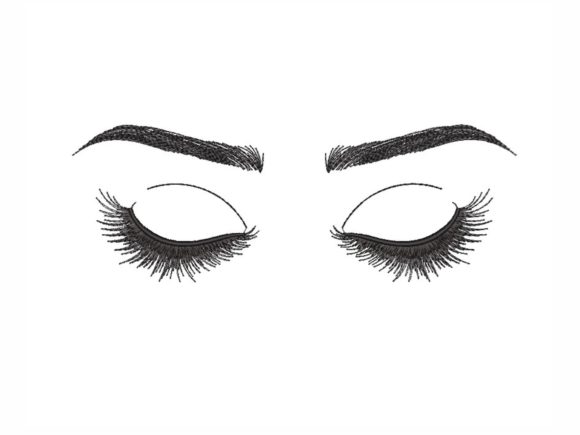
Eyelashes lands with quiet confidence—not flashy, not fussy. It’s stylized but grounded in realism: the curve is subtle, the taper is natural, and there’s just enough negative space between each lash to prevent fill-stitch bleed on lightweight fabrics. It doesn’t scream “beauty”—it whispers it. That’s rare. Most eyelash designs go cartoonish or overly dramatic, which limits where you can use them without looking like a costume piece. This one fits seamlessly into modern, minimalist, and even vintage-inspired branding. It’s not just an embellishment; it’s a visual tone-setter.
Where It Shines (and Where It Asks for Thought)
On a medium-weight canvas tote bag? Perfect. The design sits cleanly above the seam line, reads well from 3 feet away, and adds personality without overwhelming the fabric’s texture. On a baby blanket? It held up beautifully—soft satin stitch edges, no thread snagging, and zero pucker when I used tear-away + light cutaway stabilizer. But here’s where attention matters: Eyelashes isn’t built for ultra-tiny hoops. If you’re planning a cap front or a child’s beanie, check your smallest hoop size first. The outer lashes extend just enough to need breathing room—about 3.5 inches minimum width to preserve definition.
It also behaves differently across fabric types. On smooth cotton poplin or sateen bedsheets? Crisp, elegant, professional. On textured terry cloth (like a kitchen towel) or looped fleece? I recommend reducing stitch density slightly in your software—or switching the outermost lash strokes to a clean running stitch for clarity. Dense fill areas can blur on high-pile surfaces, and Eyelashes relies on clean lines to communicate its intent.
What Customers Notice (Before They Even Read the Label)
I showed the embroidered tote to five people—no context, no branding—just the bag with Eyelashes centered near the bottom hem. Four said, “That feels like self-care,” and one said, “Looks expensive, but in a calm way.” That’s the power of restraint. This isn’t a design that shouts for attention—it earns appreciation. For Etsy sellers and small shop owners, that translates directly to perceived value. A personalized gift with Eyelashes stitched on a silk pillow cover reads as curated, not craft-fair generic. On a wedding guest book sleeve or a new-mom welcome kit, it signals thoughtfulness—not just “I found a free design online.”
Design Integrity Matters More Than You Think
Here’s what I watched closely: how the inner curve of each lash held shape after stitching, whether the thinnest tips stayed sharp (they did), and how thread color choice changed the mood. In navy thread on ivory linen? Sophisticated, almost editorial. In metallic gold on charcoal sweatshirt fabric? Warm and luxe—but only if your machine handles metallics smoothly. Don’t assume it will. Test it. Also: avoid black-on-black unless you’re using a tonal sheen thread or adding a subtle shadow underlay. Flat-on-flat loses dimension fast.
Practical Designer Notes You’ll Want to Bookmark
- Always test on scrap fabric first—especially if pairing with stretchy knits or dark, low-contrast backgrounds.
- Check stitch density before scaling. Enlarging Eyelashes beyond 120% risks overloading fine details; shrinking below 80% may collapse the lash separation.
- Confirm stabilizer match: light cutaway for knits, tear-away for stable wovens, and bumpy mesh for towels or napkins.
- Review small details at actual stitch size—zoom in on those tapered ends in your embroidery software. If they look pixelated or jagged pre-stitch, they’ll stitch poorly.
- Test black-and-white mockups before finalizing product photos. Eyelashes gains strength in contrast—see how it reads without color bias.
- Compare light vs. dark fabric backgrounds in your digital preview. Some thread colors vanish on certain bases—especially pastels on ecru or heather grey.
- Verify licensing before selling finished products or listing Eyelashes as part of a digital embroidery bundle. Commercial use isn’t automatic—even for beauty-themed designs.
Not Just for “Beauty” Projects—But Smarter With Them
Yes, Eyelashes belongs in the Beauty category—and it excels there. But don’t box it in. I’ve used it as a subtle motif on apothecary-style tea towel sets, as a single accent on the pocket of a linen apron for a skincare studio, and even as a delicate border repeat on a custom baby quilt (scaled down and spaced). Its versatility comes from balance: it’s thematic without being literal, decorative without being distracting, and detailed without being demanding.
For craft business owners building cohesive collections, Eyelashes pairs naturally with soft florals, minimalist typography, or muted monograms—not competing, but complementing. And for embroidery designers curating digital assets, it’s a strong anchor piece: not so niche that it limits resale, not so generic that it blends in.
Final Thought: It’s About Trust—Yours and Your Customer’s
Using Eyelashes isn’t just about placing a design on fabric. It’s about trusting that the detail you spent time selecting—the curve, the spacing, the stitch rhythm—will translate into something that feels handmade, intentional, and quietly confident. And it’s about knowing your customer will feel that too. Whether you’re stitching a one-off personalized gift or producing 50 embroidered patches for a boutique launch, Eyelashes delivers consistency without compromise. It doesn’t try to do everything. It does one thing—elegantly represent beauty in motion—and it does it well.