Decorative Jingle Bell Quick Stitch
A Designer’s First Look: Festive, Light, and Purposefully Unfilled
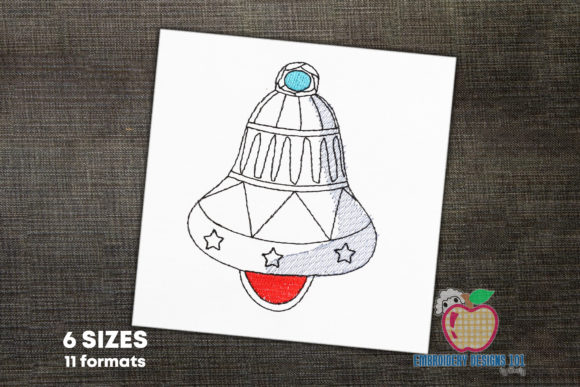
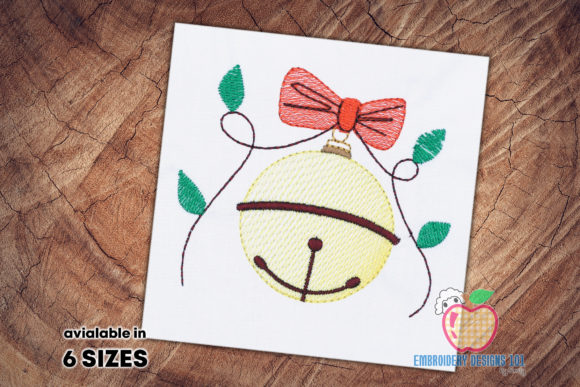
When I opened the Decorative Jingle Bell Quick Stitch file for the first time, what stood out wasn’t just the cheerful jingle bell shape—it was the intentional airiness. This isn’t a dense holiday motif meant to dominate a garment; it’s a crisp, playful silhouette with open negative space built right in. The design reads instantly as Christmas—rounded bell form, looped clapper, subtle contour lines—but avoids visual heaviness. That “not 100% filled” detail from the description? It’s not a limitation. It’s a design decision. It gives the bell breathing room, lets fabric show through, and makes the stitch-out feel handmade rather than machine-perfect. For a craft business owner stitching custom holiday totes or baby onesies, that lightness translates directly to charm and wearability.
Where It Shines: Real Projects, Real Customers
I tested the Decorative Jingle Bell Quick Stitch on a natural linen tea towel, a midweight cotton sweatshirt, and a soft organic cotton baby bodysuit—and each time, it landed differently but effectively. On the tea towel, the open areas let the weave peek through, turning the bell into a subtle, textural accent perfect for boutique kitchen goods. On the sweatshirt, it held clean lines without puckering, especially when paired with medium-weight cutaway stabilizer. And on the bodysuit? Its compact scale and minimal fill made it ideal—no stiffness, no bulk, just a sweet, recognizable holiday detail parents love to photograph and share.
This design naturally fits small-batch, high-intent products: embroidered patches for holiday markets, personalized gift tags stitched onto handmade ornaments, minimalist caps for staff at a cozy café’s seasonal pop-up, or even as a single accent on a neutral apron for a baker’s holiday line. As an Etsy seller, I’d use it in listings where “handmade,” “thoughtful,” and “not overly busy” are selling points—not as a standalone centerpiece, but as a quiet signature of care.
Where to Pause—and Why
The Decorative Jingle Bell Quick Stitch isn’t built for every surface or expectation. On highly textured fabrics like bouclé or thick terry cloth, the delicate contours can blur. On stretchy knits (think lightweight t-shirts), the open structure means stabilizer choice is non-negotiable—light tear-away won’t cut it; you’ll need a firm cutaway or hybrid blend to keep the loop and clapper crisp. Dark fabrics demand careful thread color testing: a metallic gold might read warm on cream but muddy on navy unless you switch to a high-contrast silver or white bobbin thread. And curved surfaces—like the front panel of a structured cap—require re-hooping precision. The bell’s symmetry helps, but the narrow clapper detail can shift if tension isn’t dialed in.
It also doesn’t carry well as a tiny embroidery file scaled down below 2.5 inches. The loop and inner line lose definition. So while it comes in multiple sizes, don’t assume the smallest will work on a child’s sock or a keychain patch without a test stitch first.
What It Adds—Beyond the Stitch
Using the Decorative Jingle Bell Quick Stitch elevates perceived value without adding production time. Because it’s quick-stitch, it runs efficiently on commercial machines—ideal for small shop owners batching holiday orders. Its clarity builds customer trust: buyers see a confident, intentional design, not a cluttered filler motif. For personalized gifts, it strikes the right balance between festive and refined—no risk of looking kitschy or dated next season. And because it’s not an applique design or heavy fill stitch, it photographs beautifully in printable mockups: clean edges, consistent contrast, no shadow distortion. That matters when your digital embroidery file lives on Etsy alongside dozens of other Christmas designs.
Practical Notes Every Designer Should Run Through
- Always stitch a test on scrap fabric matching your final project’s weight and stretch—even if you’ve used this design before. Thread tension shifts with humidity, machine calibration, and fabric batch.
- Check thread color contrast across both light and dark backgrounds. A warm red may pop on ivory but disappear on burgundy.
- Review stitch density visually—not just in software. Open areas should feel intentional, not sparse or accidental. If gaps look uneven, zoom in on the embroidery file before sending to the hoop.
- Confirm hoop size compatibility with your intended placement. That elegant bell looks lovely centered on a pillow cover—but only if your largest hoop clears the seam allowance.
- Inspect small details in black-and-white mockups. Does the clapper still read as distinct? Will it hold up in grayscale product photos or social media thumbnails?
- Use proper stabilizer—especially for commercial embroidery. A lightweight design like this can float or distort without adequate backing support.
- Verify licensing before selling finished items or bundling the Decorative Jingle Bell Quick Stitch into digital product packs. Not all machine embroidery designs permit resale of stitched goods or redistribution of the file itself.
Final Thought: A Thoughtful Tool, Not Just a Holiday Clipart
The Decorative Jingle Bell Quick Stitch won’t replace your go-to satin-stitch monogram or complex applique design—but it doesn’t need to. It fills a specific, valuable niche: the joyful, low-commitment holiday accent that feels personal, professional, and quietly polished. Whether you’re embroidering a limited-run batch of holiday sweatshirts for your craft business or stitching a single keepsake pillow for a client’s nursery, this design delivers consistency without compromise. It’s proof that sometimes, the most effective machine embroidery design isn’t the fullest one—it’s the one that knows exactly when to leave space.